
How to Find a Funded PhD in Germany (Even When Professors Say No)
Cold-emailing German professors and getting "no open positions"? Here is the step-by-step guide to finding structured PhDs and funded research jobs in Germany.
How to Find a Funded PhD in Germany (Even When Professors Say No)
If you are trying to secure a PhD in Germany, your first instinct was probably to search for professors in your field and send them cold emails.
And if you did, you likely received a reply that looks something like this:
> "Thank you for your interest. Unfortunately, I do not have any open positions or funding in my lab at this time."
Hearing this repeatedly is discouraging. But here is the secret: you are likely looking for a PhD in the wrong way.
In Germany, PhD candidates are not just students—they are treated as professional researchers, and their positions are often structured like actual jobs. If a professor doesn't have a research grant actively funding a new role, they physically cannot hire you, no matter how good your grades are.
Here is the step-by-step blueprint to finding a fully funded PhD in Germany, even when cold emails fail.
---
1. Understand the Two Paths: Individual vs. Structured
Before you apply, you need to understand that Germany has two completely different doctoral systems.
The Individual PhD (Traditional)
This is where you find a single professor (Doktorvater/Doktormutter) who agrees to supervise your research. You conduct your research independently.
* The Catch: You must secure your own funding (e.g., through a scholarship) or hope the professor has an open research assistant (Wissenschaftliche/r Mitarbeiter/in) job in their department.
The Structured PhD (Modern Graduate Schools)
Similar to programs in the US and UK, structured PhDs take place within a graduate school or research center (like Max Planck or Helmholtz research schools).
* The Benefit: These programs have pre-allocated budgets. When they advertise a PhD slot, the funding (either a monthly stipend or a working contract) is already secured. You do not need to ask the professor for money; you apply directly to the program.
---
2. Stop Cold-Emailing, Start Searching Job Boards
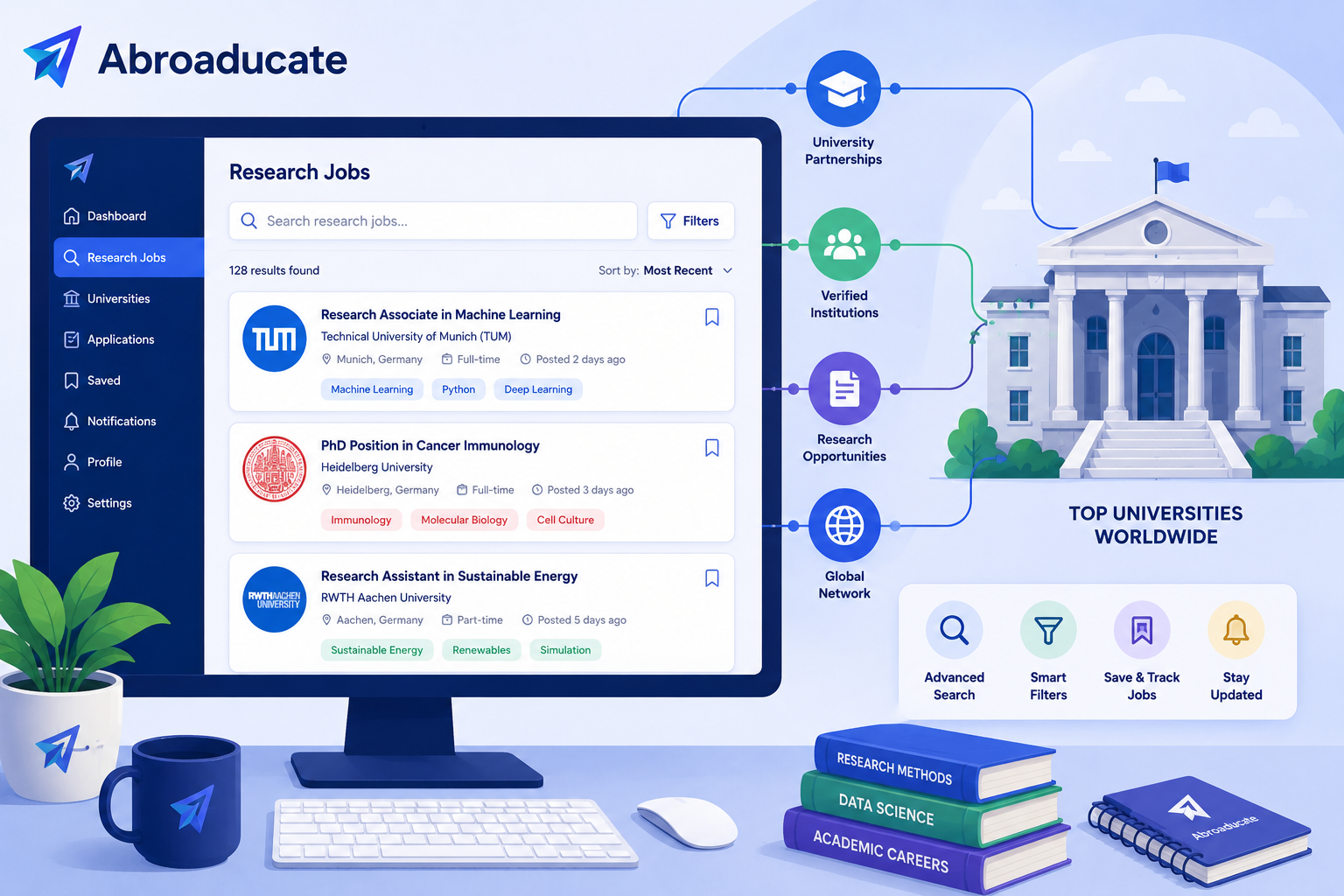
Since structured PhDs and research assistant positions are classified as jobs, they must be advertised publicly. Instead of emailing professors blindly, search these 4 databases where funding is guaranteed:
1. DAAD Database for Doctoral Programmes
The German Academic Exchange Service (DAAD) maintains a directory of structured doctoral programs taught entirely in English.
* Use it to find: English-medium graduate schools with organized funding.
* Link: DAAD PhD Programs Database (Select "Doctoral Programme")
2. Research in Germany Portal
A government-run portal designed specifically for international researchers. It lists current PhD vacancies across universities, Max Planck Institutes, Fraunhofer, and Helmholtz centers.
* Use it to find: Active job listings for researchers.
* Link: Research in Germany PhD Vacancies
3. Academics.de / Academics.com
The largest academic job portal in German-speaking Europe. Almost every public university post for a research assistant (which doubles as a PhD position) is posted here.
* Use it to find: Departmental jobs that pay you 50% to 100% of a full TV-L E13 public salary (often €2,000 to €3,500/month after tax).
* Link: Academics Job Board
4. EURAXESS Germany
A European network providing information and support services for professional researchers.
* Use it to find: Research jobs and fellowships funded by the European Union (like Marie Skłodowska-Curie Actions).
* Link: EURAXESS Job Search
---
3. Apply for Your Own Funding First
If you still prefer the individual PhD path (working directly under a specific professor on your own project), you need to change your pitch.
Instead of asking a professor "Do you have a position?" you should ask: "Will you supervise me if I bring my own funding?"
A professor will almost never reject a brilliant student who costs their department €0.
The DAAD Research Grant
The DAAD offers prestigious, fully-funded research grants specifically for doctoral candidates. It covers your flight, health insurance, and provides a monthly stipend of €1,300+ for up to four years.
How to apply: You must write a detailed research proposal and get a "Letter of Confirmation" from a German professor stating they will supervise you if* you get the DAAD grant.
* Your pitch to the professor: "I am applying for the DAAD Research Grant. I have written a research proposal on [Topic]. Would you be willing to write a supervisor agreement letter for my application?"
---
4. How to Structure Your Pitch to a Professor
If you are writing to a supervisor, avoid sending generic copy-pasted emails. Your email must stand out:
1. Keep it short: 3 paragraphs maximum.
2. Attach a Research Proposal: A 2-to-3 page document showing you actually understand the field, your methodology, and how it aligns with the professor's past papers.
3. Use an Academic CV: Format your achievements to German standards. Highlight your Master's thesis, publications, and lab skills.
> Get Expert Help: You don't have to draft these highly technical documents alone. You can use the Abroaducate AI Application Copilot to draft a compelling Statement of Purpose, refine your academic research proposal, and build a German-standard Academic CV that commands respect from professors.
A "no" from a professor doesn't mean your PhD dream is over. Switch your strategy: target structured programs, check active academic job boards, and look into external funding options today.


