Free Universities in Germany for International Students Without IELTS (2026)
If you’ve been putting off applying to German universities because you don’t have an IELTS score, this article is for you.
The short answer: yes, you can study in Germany for free without IELTS. Many German public universities accept alternative proof of English proficiency — and some don’t require a formal test at all if your previous education was in English.
Here’s everything you need to know, including a real list of programs and public universities you can apply to right now.
Does Germany Require IELTS for International Students?
No — Germany does not have a national, government-mandated requirement for IELTS. Under Germany’s federal education system, each university has the absolute autonomy to set its own language requirements for every program.
While some highly competitive courses still request IELTS, many public universities accept alternative proofs of English language proficiency, including:
- TOEFL iBT: A widely accepted alternative (usually requiring scores of 80 to 90 for graduate programs).
- Cambridge English Qualifications: C1 Advanced or C2 Proficiency certificates.
- Duolingo English Test (DET): A convenient, online alternative growing in popularity (typically requiring scores of 110 to 125).
- Medium of Instruction (MOI) Certificate: An official letter from your previous university confirming your entire degree was taught and examined in English.
- Previous English-Taught Degree: Having a Bachelor’s or High School degree from an English-speaking country (like the US, UK, Canada, Nigeria, Ghana, or Australia) often waives any test requirement automatically.

What is a Medium of Instruction (MOI) Letter and How Do You Get One?
The Medium of Instruction (MOI) letter is the ultimate hack for international students. It is an official document issued by your previous academic institution (high school or university) confirming that English was the sole medium of instruction and assessment.
For universities that accept it, submitting an MOI waives the requirement to sit for expensive exams like the IELTS, saving you over $250.

How to Get Your MOI Letter in 5 Steps:
- Contact the Registrar’s Office: Reach out to the student records or registrar office of your graduating institution.
- Request Language Verification: Ask for an official statement certifying that your entire curriculum was conducted in English.
- Ensure Letterhead details: The letter must be printed on official school letterhead and include your full name, student ID, enrollment dates, and degree earned.
- Secure Authorized Signature: Make sure the document is signed and stamped by the registrar, dean, or examinations head.
- Create a High-Quality Scan: Scan the original stamped letter as a PDF. Keep it handy to upload directly to German application portals like Uni-Assist or individual university portals.
List of 8 Tuition-Free German Universities Accepting Students Without IELTS
To make your search easier, here are 8 top-tier, tuition-free German public universities that accept alternative proofs of English proficiency (like an MOI letter) for English-taught programs:
1. Technical University of Berlin (TU Berlin)
TU Berlin is a prestigious member of the TU9 alliance of leading German technology institutes. It offers top-ranked engineering, computer science, and management programs.
- IELTS Alternative: Accepts a Medium of Instruction (MOI) letter if your entire undergraduate program was conducted in English.
2. Bielefeld University
A modern research-oriented university in North Rhine-Westphalia, Bielefeld is known for its interdisciplinary study models, sociology, and molecular biology.
- IELTS Alternative: Accepts official letters from your previous school confirming prior instruction was in English.
3. Anhalt University of Applied Sciences (Hochschule Anhalt)
Located in central Germany, Hochschule Anhalt is a great option for applied sciences, design, agriculture, and engineering.
- IELTS Alternative: Accepts MOI certificates for several English-taught Master’s courses.
4. Berlin School of Economics and Law (HWR Berlin)
One of Germany’s largest business schools, HWR Berlin offers highly practical international business, finance, and management degrees.
- IELTS Alternative: Allows English proficiency proof through previous degree certificates or official MOI letters.
5. Flensburg University of Applied Sciences
Positioned near the Danish border, Flensburg is renowned for its energy engineering, marine technology, and business informatics programs.
- IELTS Alternative: Waives IELTS if you submit an MOI letter or completed high school/bachelor’s studies in English.
6. European University Viadrina Frankfurt (Oder)
Located on the German-Polish border, Viadrina focuses on humanities, social sciences, and law, emphasizing international and European studies.
- IELTS Alternative: Accepts MOI letters as solid proof of language proficiency.
7. Clausthal University of Technology (TU Clausthal)
A leading technical institute in Lower Saxony specializing in metallurgy, energy engineering, and raw materials.
- IELTS Alternative: Accepts an official MOI certificate from your previous university.
8. Bonn-Rhine-Sieg University of Applied Sciences (H-BRS)
Located in the Cologne-Bonn region, H-BRS offers excellent, modern labs and programs in biology, chemistry, and business.
- IELTS Alternative: Accepts MOI letters for English-taught Master’s degrees.
The Real Cost of Studying in Germany
Even though tuition at these public universities is €0, studying in Germany isn’t completely free. You must budget for the following:

1. The Semester Contribution (Semesterbeitrag)
Every public university charges an administrative semester fee, typically between €150 and €350 every six months. This fee pays for student services, administration, and most importantly, a Semesterticket — a public transit ticket that gives you free, unlimited travel on all local buses, trams, and regional trains in your state.
2. The Blocked Account (Sperrkonto)
To obtain a German student visa, you must prove to the German government that you can cover your living costs. You do this by depositing a mandatory amount into a Blocked Account (Sperrkonto). For 2026, this amount is €11,904 per year (or €992 per month). The bank releases €992 to you each month to pay for rent, food, health insurance, and study materials.
- Tip: If you secure a fully funded scholarship (like a DAAD or Erasmus Mundus award), the scholarship certificate replaces the need for a blocked account.
3. Student Visa Part-Time Work Limits
To offset living costs, German student visas permit you to work part-time. You can work 140 full days (or 280 half days) per year. Part-time jobs (minijobs) usually pay €12 to €16 per hour and are a great way to cover your groceries and rent while studying.
Match Programs to Your Qualifications on Abroaducate
Finding tuition-free universities and checking their language test waivers manually takes hours of tedious spreadsheet work. That is why we built Abroaducate.
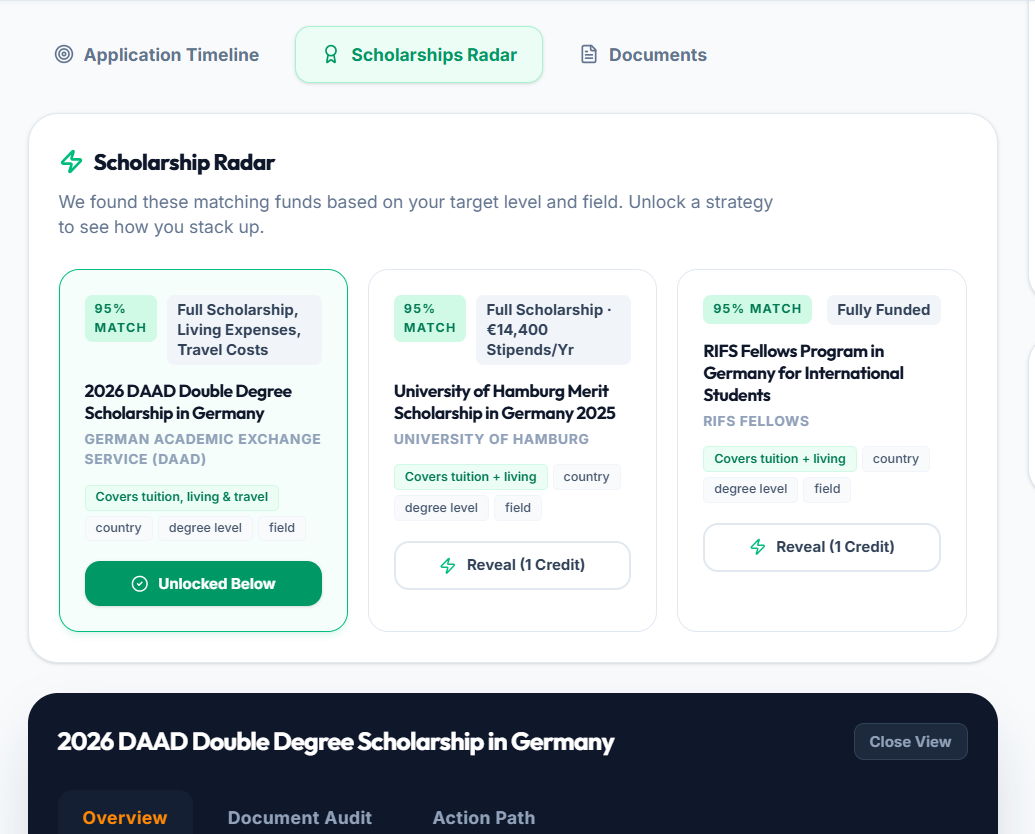
Instead of searching blind, you can use our program finder to filter for English-taught degrees in Germany, and then jump to the Scholarship Radar tab to instantly view national scholarships (like DAAD) matched directly to your academic profile.
FAQ Section
Can I get a German student visa using only an MOI letter?
Yes! German embassies evaluate your visa application based on your official university admission letter (Zulassungsbescheid). If the university accepted your MOI and issued you an admission offer, the embassy will accept it as sufficient proof of English proficiency. You do not need to show an IELTS score to the visa officer if the university did not require it.
Do I need to speak German to study in Germany?
For English-taught programs, no German language skill is required for admission. However, learning basic German (A1/A2 level) is highly recommended for everyday life, making friends, shopping, and securing part-time student jobs.
Is there an age limit to apply for tuition-free studies in Germany?
No, there is no official age limit for university admission or student visa applications in Germany. Whether you are 18 or 38, as long as you meet the academic requirements and have a valid study plan, you can apply.
Ready to Start Your German Journey?
Studying in Germany without IELTS is highly achievable if you follow the right steps. Focus on securing a Medium of Instruction letter from your registrar, research programs that accept test waivers, and utilize Abroaducate to keep track of your scholarship opportunities and deadlines.